
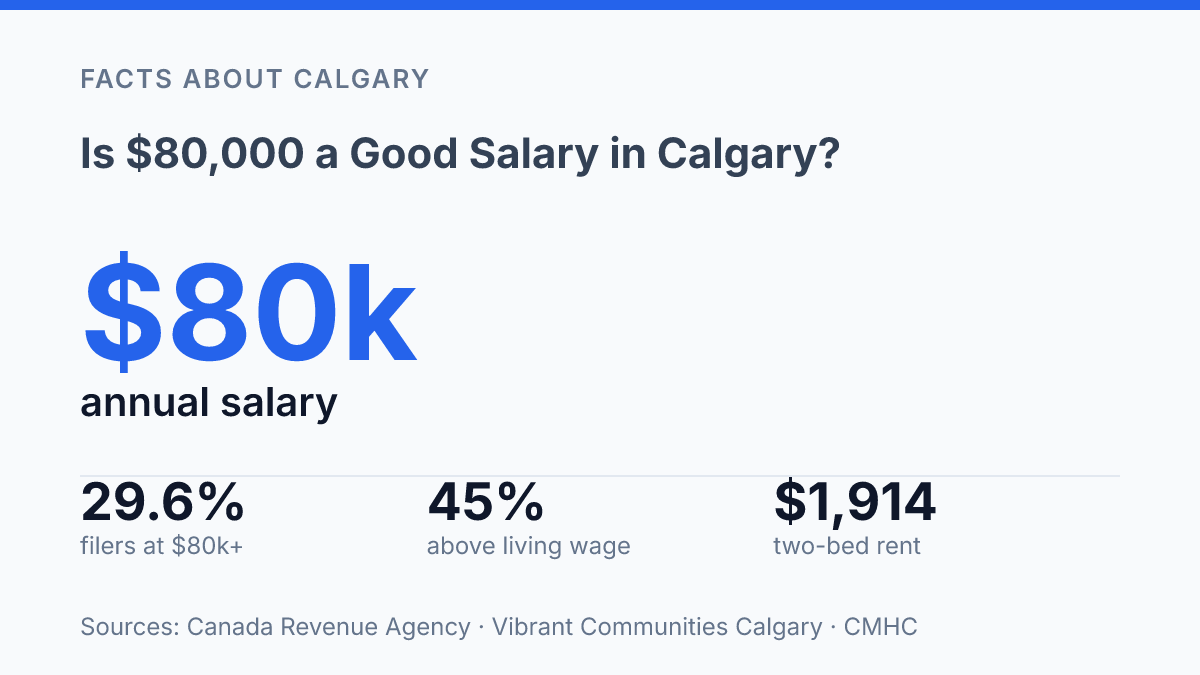
Is $80,000 a good salary in Calgary? At 40 hours a week, it equals about $38.46 an hour, just under Calgary’s June 2025 average hourly wage of $39.50, yet roughly 45% above the city’s 2025 living-wage benchmark. That split is the core of the question: the same income can look slightly below average in wage surveys, clearly above many tax filers’ employment income, and still vulnerable to rent, commuting, child care, or mortgage costs.
CRA data for the 2024 tax year places $80,000 above the average Calgary employment-income filer, while about 29.6% of all Calgary CMA filers reached $80,000 or more. The article examines that income from four angles: pay comparisons, after-tax cash flow, household and neighbourhood differences, and the conditions that make the salary either comfortable or tight.
How $80,000 compares with Calgary pay levels
$80,000 sits above most Calgary individual income benchmarks, even though it is not quite above the city’s latest average hourly wage when converted to full-time hours. Treated as a 40-hour, 52-week salary, $80,000 equals about $38.46 an hour, slightly below Calgary’s June 2025 nominal average hourly wage of $39.50; the same City of Calgary Labour Market Review reported that the city’s real average hourly wage fell from $22.60 in May 2024 to $22.30 in May 2025. That comparison places the salary close to the citywide average for paid work, but not clearly above it when measured by hourly earnings.
Against lower-end wage benchmarks, the gap is much larger. Alberta’s general minimum wage is $15 an hour, which works out to $31,200 a year at 40 hours per week for 52 weeks before tax. On that basis, an $80,000 salary is about 2.6 times a full-time minimum-wage income, showing that it is well above the statutory wage floor rather than merely above entry-level earnings.
Federal income data point in the same direction. Canada Revenue Agency tax statistics for the Calgary CMA show that employment-income filers reported about $67.668 billion in employment income in the 2024 tax year across 961,840 filers, or roughly $70,353 per filer. An $80,000 salary is therefore about 14% higher than that average, while CRA income-band data show that about 29.6% of Calgary CMA tax filers had total income of $80,000 or more.
A household comparison is useful but needs care because it measures a different unit. Statistics Canada’s 2021 Census Profile reported Calgary CMA median after-tax household income at about $87,000 in 2020, which means one gross salary of $80,000 should not be read as equivalent to the median household’s spendable income. The benchmark is strong for an individual earner, but its practical strength depends on taxes and the number of people supported by that income.
What $80,000 may cover after tax
The usable monthly pay from an $80,000 Calgary salary is likely closer to $5,058 a month than to the headline figure divided by 12. Using CRA-based 2026 assumptions for a single Alberta employee with standard credits and no RRSP deduction, federal income tax is roughly $9,300 and Alberta income tax is roughly $4,400. CPP, including the second additional CPP contribution, adds about $4,446, and EI is capped at about $1,123, leaving estimated annual take-home pay near $60,700 before any workplace benefit premiums, pension deductions, union dues, or voluntary savings contributions.
Housing is the largest variable in whether that after-tax income feels flexible or constrained. CMHC’s 2025 Rental Market Report lists Calgary’s average purpose-built two-bedroom rent at $1,914 per month, which would absorb about 38% of the estimated net monthly income if paid by one earner. CMHC also reported that average two-bedroom turnover rent fell from $1,927 in 2024 to $1,836 in 2025, suggesting slightly easier conditions for some new leases, but not enough to make rent a minor line item.
Everyday costs then determine how much room remains for savings, debt repayment, or irregular expenses. A Calgary Transit adult monthly pass is $115, while a car-based budget can be much higher once insurance, fuel, maintenance, registration, and parking are included. For food, the Alberta Living Wage Network reported that food costs were about 6% higher in 2025, and Statistics Canada’s food price data continues to show pressure on store-bought staples; for one adult, a practical grocery allowance often needs to be several hundred dollars per month rather than a token amount.
On these assumptions, one adult sharing housing costs or renting below the city average may have a stable budget. The same income can feel tight for a household covering a full two-bedroom rent, car costs, child-related expenses, or higher debt payments, because those fixed costs reduce the room created by an above-average gross salary.
Household type and neighbourhood matter
A City Centre row home cost more than twice as much as an East Calgary row home in CREB’s 2025 outlook, with benchmark prices of $606,075 and $296,642 respectively. According to CREB’s 2025 Calgary and Region Yearly Outlook, that is a difference of more than $309,000 within the same city, before considering property tax, condo fees, insurance, or mortgage-rate exposure. The practical result is that the same salary can support very different housing choices depending on whether the household is targeting an inner-city purchase, a lower-cost district, or a rental farther from the core.
Central Calgary often carries a price premium because it can reduce commute time and place households closer to downtown employment, transit, universities, hospitals, and established services. Outer communities such as Airdrie, Okotoks, and Cochrane can offer more space or a different purchase-price profile, but the comparison is not only about rent or mortgage payments. A lower housing cost can be partly offset if it requires more driving, paid parking, higher fuel use, vehicle maintenance, or a second car for a two-worker household.
Household structure changes the calculation just as much as location. A single-income renter or owner carries housing, utilities, transportation, insurance, and debt payments from one paycheque, so fixed costs take up a larger share of available cash. A dual-income household may face higher total expenses, especially with children, but two earnings streams can make the same housing payment much easier to absorb and can provide more flexibility when interest rates, rent, or repair costs rise.
Childcare and debt can narrow the gap between a solid salary on paper and a comfortable monthly budget. The Alberta Living Wage Network reported that child-care costs were about $1,000 higher in 2025, while transportation costs rose sharply for some household types.
Student loans, car payments, credit-card balances, or support obligations have a similar effect because they reduce the amount available for housing choice. Higher earnings therefore do not automatically translate into better affordability when they are paired with a more expensive neighbourhood, a longer commute, or large recurring obligations.
When $80,000 is strong, and when it is stretched
At $80,000, the dividing line in Calgary is often not basic spending itself but whether rent, vehicles, childcare and debt absorb too much income before savings begin. According to the Calgary living-wage release for 2025, the local benchmark was $26.50 an hour, so this salary sits comfortably above a subsistence-style affordability threshold. That does not make it uniformly comfortable, because the salary is assessed against household obligations rather than against a wage benchmark alone.
For a single renter, the income is generally strong if housing is moderate and transportation costs are controlled. A single earner renting a smaller unit, using transit or owning a paid-off vehicle can usually cover regular costs while still leaving room for emergency savings, debt reduction and periodic discretionary spending. The same income becomes tighter when a newer lease, parking, insurance, fuel, student loans or consumer debt all compete for the same after-deduction pay.
A couple can experience this salary in two different ways. If $80,000 is the only household income, it may cover a modest rental lifestyle but leave less room for rapid saving, especially if one partner is in school, between jobs or carrying debt. If it is one income within a two-earner household, it becomes much stronger because rent, utilities and many fixed costs are shared across two paycheques rather than supported by one.
Families with children face the narrowest margin at this income level. Larger housing needs, childcare, school costs, activities, higher grocery bills and often more vehicle dependence can turn a solid individual salary into a stretched household budget. It may still be workable, but the difference between stable and strained often depends on whether the family has subsidized childcare, low debt, or a second income.
In Calgary’s labour market, this pay level is not unusual in established energy roles, licensed trades, technical and software positions, construction supervision, engineering-adjacent work, finance, and many public-sector or unionized professional roles. It is more clearly above average in lower-paid service, retail, hospitality, entry-level administration and some early-career nonprofit roles. The practical test is whether fixed commitments leave enough margin to build an emergency fund and pay down debt; without that margin, a good gross salary can still feel limited month to month.
Why the margin matters more than the headline salary
The practical measure of $80,000 is not whether it clears a single benchmark, but how much room remains after the fixed costs that cannot be adjusted quickly. Calgary’s 2025 rental data shows why that margin can shift: a two-bedroom average rent near $1,914 absorbs about 38% of estimated net pay for a single earner, while location choices can move ownership costs by hundreds of thousands of dollars.
If wage growth trails housing, transportation, or child-care inflation, the same salary will buy less stability over time. The strongest next step is to test the income against an actual monthly budget, not an average-city profile.
Frequently Asked Questions
Q: Is $80,000 a good salary in Calgary for a single person?
A: For many single adults, $80,000 can be a workable income in Calgary if housing costs are moderate and debt is limited. It sits above many median earnings benchmarks, but after tax, rent, transportation, food, and savings, the margin can still be tighter than it first appears. The result depends heavily on neighbourhood choice and lifestyle spending.
Q: How far does an $80,000 salary go in Calgary after tax?
A: A salary of $80,000 is reduced by federal and provincial income tax, Canada Pension Plan contributions, and Employment Insurance premiums. The amount left for monthly expenses is typically enough for basic living costs, but it may not stretch comfortably if rent, childcare, or car expenses are high. The practical value of the salary depends on fixed costs more than the gross number alone.
Q: Can a family live comfortably on $80,000 in Calgary?
A: A family can live on $80,000 in Calgary, but comfort is strongly affected by housing, childcare, and the number of dependants. Two incomes, shared housing costs, or lower debt levels usually make the budget more manageable. With one income supporting several people, the same salary can feel much tighter.
Q: What monthly budget is reasonable on an $80,000 income in Calgary?
A: A reasonable budget on this income usually prioritises housing, transportation, groceries, and savings before discretionary spending. Because net pay is lower than gross pay, rent and car costs should be assessed against take-home income rather than salary alone. Fixed expenses that exceed a large share of monthly income reduce flexibility quickly.
Q: How does $80,000 compare with the average salary in Calgary?
A: An $80,000 salary is generally above average for many local workers, although comparisons vary by occupation and experience level. That does not automatically mean it is high-cost-of-living proof, because housing and household size can offset the advantage. The meaningful comparison is how the income aligns with specific expenses and financial goals.