
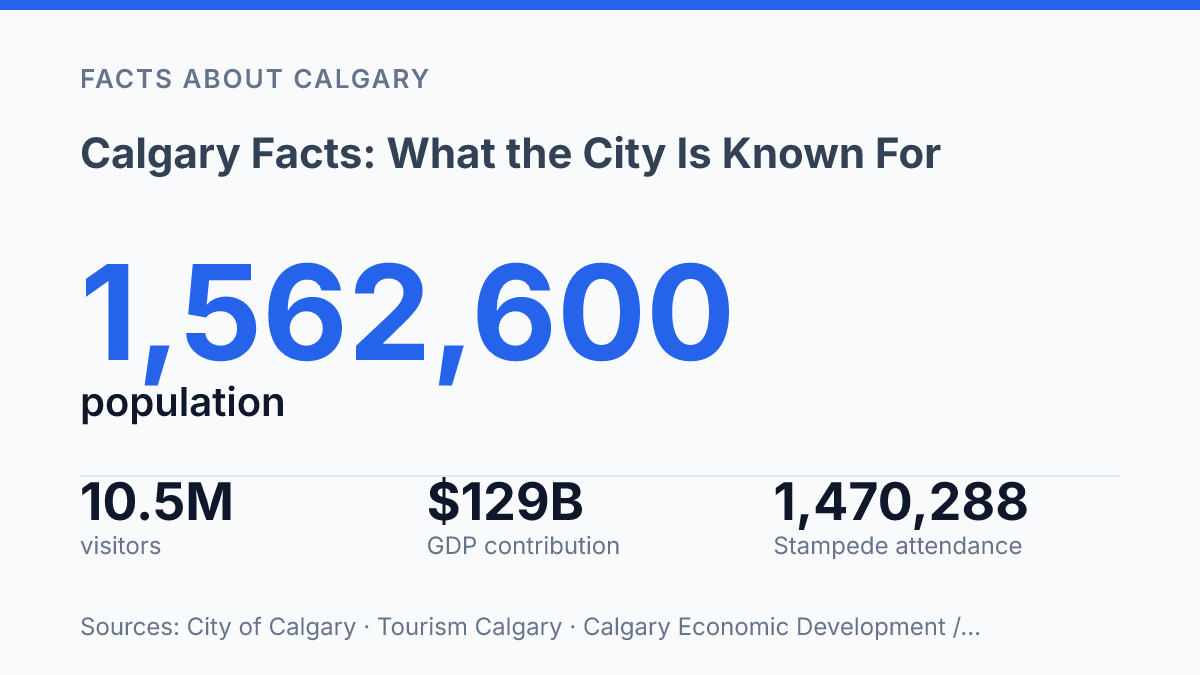
Calgary is projected to reach 1,562,600 people by April 2025, and most of that jump comes from newcomers rather than births. That changes the way the city works.
Fast growth puts pressure on housing, roads, schools, and parks. It also explains why the city feels more complex than its old cowboy shorthand suggests.
The numbers tell a sharper story. A $129 billion GDP contribution sits beside a tech workforce that grew 61.1% in three years. The Stampede still draws crowds big enough to move Alberta’s economy, but daily life is shaped just as much by pathways, weather swings, neighbourhood price gaps, and access to the mountains. In my honest opinion, the city is most interesting where its old image stops matching its present reality.
Calgary at a Glance
The city can look flat and prairie-built at street level. The Canadian Rockies sit close enough to shape its identity.
Set in southern Alberta, Canada, it sits on the western edge of the Prairies, where open plains begin to rise into the foothills. That position matters. You get a major urban centre with office towers and suburban growth, yet mountain access stays part of daily imagination.
The modern city traces its civic starting point to 1884, when it was founded as Fort Calgary. That origin matters. It doesn’t explain why the place feels so current.
The stronger story is scale: fast expansion, high mobility. A region that keeps pulling in newcomers.
A commonly cited metro figure of 1.3 million already puts the area among Canada’s major urban centres. More recent growth makes that number feel conservative: a municipal forecast projected the population at 1,562,600 in April 2025, up 3.5% year over year, with 42,600 net migrants driving most of the increase.
That growth creates energy. It also adds pressure.
Housing, roads, schools, transit, and public space all have to absorb more people at once. In my view, the key thing to understand is that this isn’t a small western outpost with a skyline. It’s a regional anchor whose size now shapes much of Alberta’s future.
Why the city’s economy stands out
A city doesn’t contribute $129 billion to national GDP by being a one-industry town with a cowboy hat on top. Energy still sets the tone, and major companies such as Enbridge and Suncor Energy tie the city to pipelines, refining, trading, engineering, and corporate services. But the money around that sector also feeds law firms, banks, insurers, consultants, and real estate desks.
The 1970s oil boom turned Calgary into a command centre for western Canadian business. Corporate offices expanded. Towers went up.
Specialized talent followed the capital. In my honest opinion, the part people miss is that the boom didn’t just create oil jobs. It created a professional class built around managing risk, infrastructure, land, finance, and regulation.
That success has a cost. Energy built the city’s modern profile. That same dependence makes every downturn harder than residents want to admit.
A drop in commodity prices can hit hiring, office demand, tax revenue, and consumer confidence at the same time. Few sectors lift a city as fast. Few expose it as clearly when the cycle turns.
Downtown shows that contrast better than any slogan. The City’s Greater Downtown Plan cited 43,000+ downtown office workers before remote and hybrid work reshaped daily routines. That figure matters because it represents more than desks.
It supported coffee shops, lunch counters, dry cleaners, transit trips, and after-work spending. When office patterns changed, the street-level economy felt it.
The broader economy now has more legs under it. CBRE’s 2025 Scoring Tech Talent report ranked the city 17th among 50 North American tech markets after its tech workforce grew 61.1% from 2021 to 2024, reaching 64,600 workers. Logistics also matters, helped by major rail, road, air cargo, and distribution links.
Finance remains deep too. The energy story still dominates the brand. It no longer explains the whole machine.
Signature events and outdoor access
More than 1.47 million people passed through the Stampede gates in 2025, enough to turn a ten-day festival into a citywide stress test. Global News reported 1,470,288 attendees that year, just shy of the previous record. An MNP study put the event’s Alberta-wide economic impact at $721.2 million.
The first Stampede began in 1912. The event has grown from a frontier-style showcase into the 10-day anchor of the summer calendar.
The Calgary Stampede remains the city’s best-known annual draw, but its real reach goes beyond rodeo. Hotels fill, restaurants get packed, and office towers suddenly feel tied to tourism as much as business.
That cowboy image sells well. It’s also incomplete. Many visitors come for food, concerts, patios, cultural festivals, and quick trips west rather than for livestock shows or arena events. In my humble opinion, the city is at its best when it lets that mix show instead of leaning too hard on one costume.
A roughly 1.5-hour drive from Calgary to Banff townsite puts Banff National Park within easy day-trip range for visitors who want alpine lakes, hiking trails, ski hills, or mountain views without changing hotels. That access is a major advantage.
It doesn’t turn the city into a mountain town. You still get the restaurants, venues, sports crowds, and neighbourhood routines of a large urban centre.
Tourism reflects that split identity. The local tourism agency’s 2025 annual report said the city welcomed 10.5 million visitors and generated $3.3 billion in visitor spending. Those numbers point to something broader than a single summer event: people arrive for the western brand, then stay for the urban and outdoor combination.
Weather, neighborhoods, and daily life
Sunshine can trick you here: a lunch-hour thaw can turn into a face-stinging cold snap before the week is out. Winter isn’t just cold. It’s unstable.
Chinook winds can push temperatures upward fast, melt snow into slush, and make February feel briefly forgiving. But the same season can drop to -30°C or colder. That swing surprises newcomers more than the cold itself.
Planning conversations still carry the memory of the major local flood in 2013, when river levels forced a harder look at where people build, insure, and rebuild. You see its legacy in flood maps, riverbank work, stormwater rules. A more cautious approach to low-lying redevelopment near the Bow and Elbow rivers.
The risk didn’t disappear after the cleanup. It became part of how the city thinks.
The sharpest neighborhood contrast shows up in East Village and Bridgeland. East Village turned former rail and warehouse land into a denser riverfront district with condos, public space, and cultural anchors.
Bridgeland feels more lived-in, with older homes, local restaurants. A walkable main-street pattern that gives it a different pace. In my view, that contrast matters because renewal works best when it doesn’t flatten every area into the same polished product.
Suburban life works differently. The city spreads far, and daily routines can depend heavily on where you live relative to work, school, and transit. That space gives many households bigger homes and quieter streets.
It can also stretch commutes. According to municipal parks data, residents have access to more than 1,000 km of pathways, so outdoor movement is woven into ordinary life, not saved for weekends.
The long-term climate picture adds another wrinkle. The city’s 2024 Climate Projections estimate historical median hot days at 15.2 per year, rising to 42.0 days in the 2050s under its modeled scenario.
That means daily life is being shaped by both winter volatility and hotter summers. Sunshine helps sell the place, but comfort here has always come with conditions.
What the next decade will test
The next decade will test whether growth makes the city better, not just bigger. The City of Calgary climate projections point to the 2050s bringing 42.0 hot days in a typical year, compared with 15.2 historically.
That’s not a footnote. It changes homes, streets, parks, workdays, and who can afford comfort.
If you’re sizing up Calgary as a place to visit, invest, or live, don’t stop at the skyline or the Stampede. Look at migration, heat, housing.
The way neighbourhoods are shifting block by block. In my humble opinion, the real story isn’t whether the city is growing. It’s whether it can stay livable while everyone else discovers it.
Frequently Asked Questions
Q: What is Calgary best known for?
A: Calgary is known for the Calgary Stampede, the oil and gas industry, and its fast-growing downtown. It also sits right on the edge of the Rockies, so people get city life and mountain access in one trip. In my view, that mix is the city’s biggest advantage.
Q: Why do people move to Calgary?
A: People move to Calgary for jobs, lower taxes than some other major Canadian cities, and easy access to outdoor recreation. The city attracts newcomers who want a strong economy without giving up weekend trips to the mountains. That tradeoff is hard to beat.
Q: Is Calgary a good place to visit in summer?
A: Yes, summer is one of the best times to visit Calgary. The Stampede brings huge crowds. The city also has festivals, park space, and long daylight hours. If you want the fullest version of the city, summer gives you that.
Q: How close is Calgary to Banff and the Rockies?
A: Calgary is a practical base for reaching Banff and other mountain spots. Banff is about 1.5 hours away by car. You can stay in the city and still get an easy mountain day trip. That convenience is a big reason travelers use Calgary as their starting point.
Q: What kind of climate does Calgary have?
A: Calgary has cold winters, warm summers, and very fast weather changes. Chinook winds can raise temperatures quickly in the middle of winter, which surprises a lot of first-time visitors. You get real seasonal contrast here, and that’s part of the city’s identity.